.png)
Manchester 2v1 to 3v2+1
ADDED TO FAVOURITES
Practice Breakdown:
Number of Players: 8 | Pitch size: 30x36
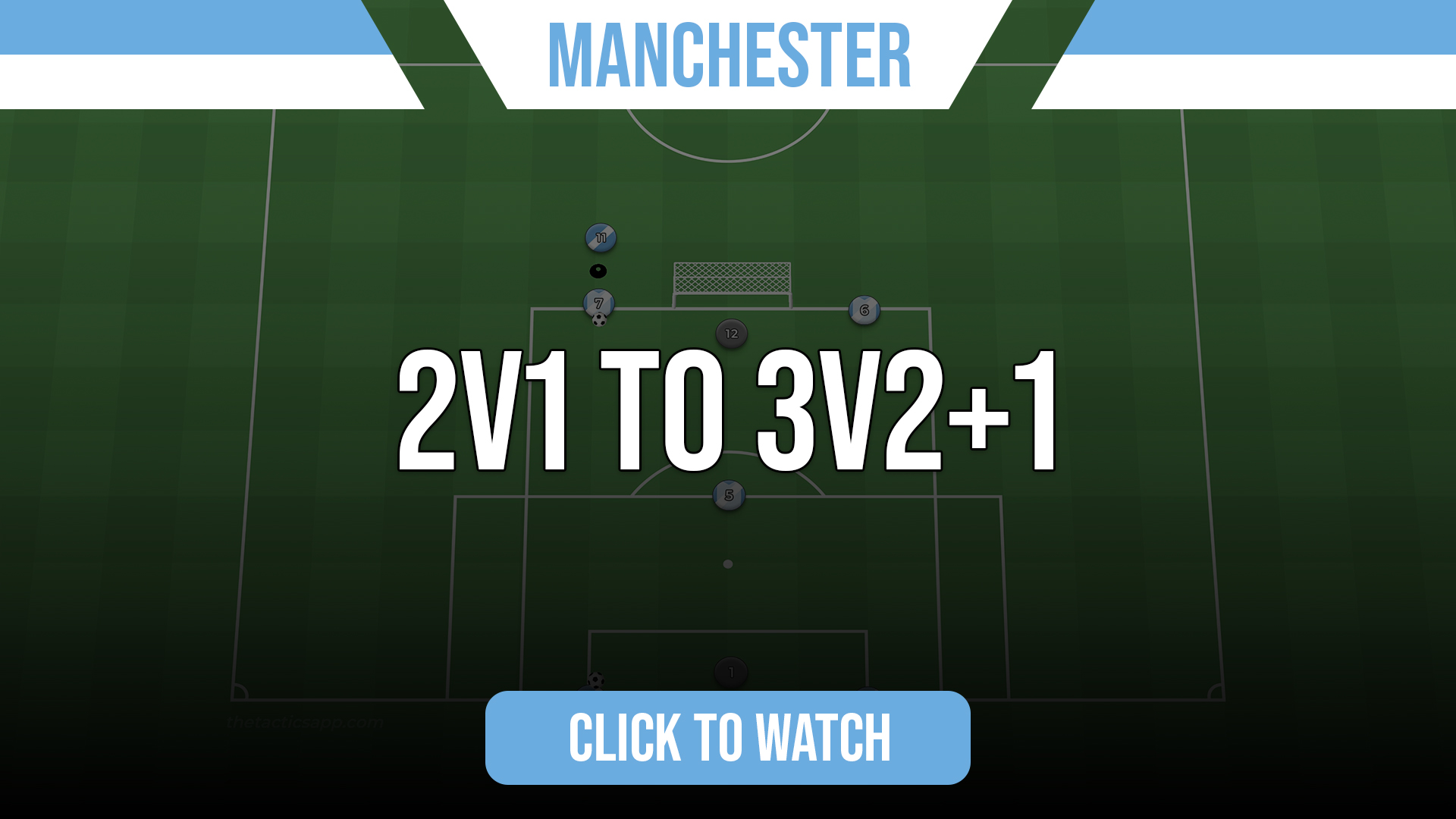
The practice begins with a 2v1 attacking situation where two attackers combine quickly to beat a single defender and finish on goal. As soon as the 2v1 phase ends (regardless of outcome), the two attackers must quickly transition to defend against a new wave of three attackers, creating a 3v2 counter-attack in the opposite direction.
During the 3v2 phase, a recovering defender from the original team can sprint back into play to create a 3v3 scenario, encouraging realistic game-like transitions, recovery runs, and defensive resilience under pressure.
• In the initial 2v1, encourage sharp combination play, early decision-making, and clinical finishing to exploit the advantage.
• Focus on the attackers' reaction time after the first phase, demanding immediate recovery and defensive positioning without delay.
• Highlight the need for defensive communication and compactness when facing the 3v2 situation, forcing attackers wide or delaying play.
• Stress the importance of the recovering defender's work rate, timing their run to have a real impact on the 3v3 transition.
• Reinforce positive transition habits by rewarding quick reactions, both offensively and defensively, during the changeover between phases.
Time Limit to Score in 3v2 Phase
Impose a 6–8 second limit for the attacking team during the 3v2 phase to attempt a shot, forcing quicker decision-making and a game-realistic tempo.
Focus: Improving speed of thought in attacking overloads and adding urgency to transitional moments.
Delayed Entry for Recovering Defender
Slightly delay the recovering defender’s release (e.g., after 2 seconds) to initially challenge the 3v2 before balancing into a 3v3 scenario.
Focus: Sharpening attackers' ability to exploit brief overloads and defenders' ability to recover positioning dynamically.
