.png)
3 YEARS OF AMORIM - WHAT NEEDS TO CHANGE TO MAKE IT A SUCCESS.
- Mohamed Fathalli

- Oct 9, 2025
- 7 min read

After Sir Jim Ratcliffe’s recent comments, it looks like Ruben Amorim is here to stay at Manchester United despite the inconsistent results and performances. That means the focus now shifts away from questions about his job security and more toward how he can actually turn things around. But does it really make sense to think about what Ruben needs to change? After all, the inverted central centre-back, the overreliance on wide progression, and the 5-2-3 out of possession are all issues the Portuguese coach continues to ignore as he insists on sticking with his beloved “system.”
Well, if the system means formation, maybe that doesn’t need to change. Maybe it’s about how you use it. And perhaps that win against Sunderland gave us a few signs that Amorim is feeling the heat and might finally be ready to adjust.
In this article, the focus will be on the out-of-possession phase, aiming to identify what exactly - beyond formation - Ruben needs to change for United to become tougher to beat.
The 5-2-3 Did Enough Damage
It’s one thing to change your lineup and tactics, but it’s another thing entirely to change your principles and intentions. Maybe that’s the biggest paradox Ruben Amorim is facing right now: the struggle to adjust without losing what defines his football. The truth is, it’s not as complicated as it seems. You can hold on to your core ideas about how the game should be played while still tweaking your setup and adapting your strategy.
When it comes to defending, Amorim’s 5-2-3 formation has turned into something opponents are eager to target. Whether it’s by using the goalkeeper as an extra man during the build-up or by having a midfielder drop deep to join the back line, teams have found ways to stretch and pull apart his structure. Manchester United’s front three, in particular, are too easy to play around and overload. In midfield, relying on only two players creates another problem, since a fullback or winger drifting inside, or even a striker dropping deep, is enough to create superiority and progress the ball forward.
And for the backline, Amorim often asks his center backs to step into midfield to deal with this issue, but even that plan has been countered. Opponents have learned to pin those defenders back, trapping them in their line and exposing the spaces in front of them.

The vulnerabilities have been there for everyone to see since last season. The hard-fought 3-1 win against Southampton at Old Trafford, inspired by Amad’s brilliance, is just one of many examples. This season, teams have continued to use the same approach to expose the weaknesses of the 5-2-3 setup. The patterns are familiar now: opponents look to exploit the system by creating numerical advantages, overloading the central areas, or pinning Manchester United’s back line in place. The screenshots below show moments that happened just seconds before goals were conceded, each one highlighting how easily teams have learned to take advantage of those flaws.

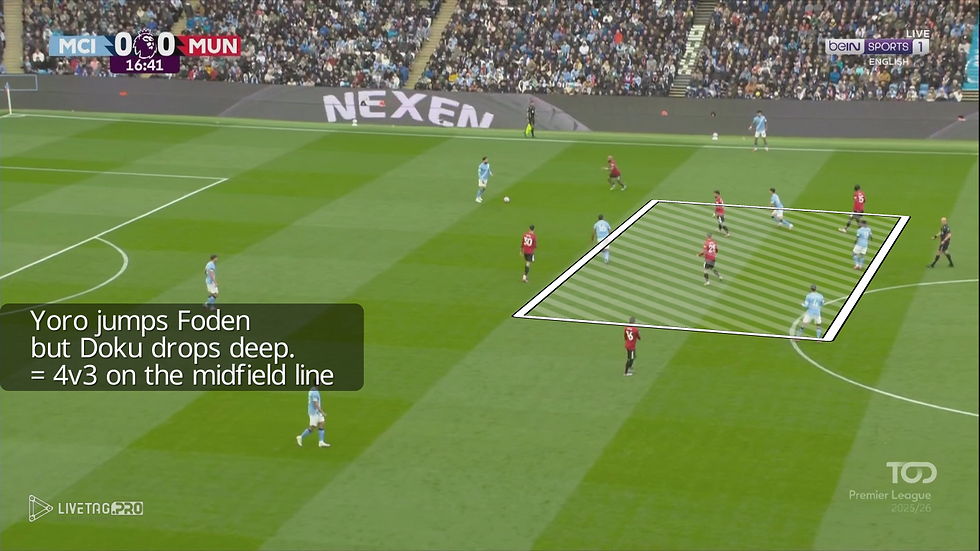

After the 3-1 loss away to Brentford, a game that was disappointing in almost every way, many people thought Ruben Amorim’s next match against Sunderland at Old Trafford would be his last if things didn’t improve. That kind of pressure can change the way a manager approaches a game. Maybe that’s why we saw something different in Manchester United’s out-of-possession setup against the Black Cats. However, looking back at, was it really different?
A Change Has Finally Taken Place, Or Has It?
Manchester United finally managed to get their first clean sheet of the season against Sunderland, something they had only achieved four times in the previous five months, against Leicester City, Manchester City, and Aston Villa. This improvement came with a slight adjustment in Amorim’s defensive approach.
When the ball moved into the central areas or looked to be played toward the left side, both Sesko and Mbeumo would look to alternate between pressing the centerbacks and covering the number six. Amad would step up into midfield, joining the press while Mount held his position on the second line. This adjustment helped United close down passing lanes more effectively and made it harder for Sunderland to build through the middle. It was the 4-4-2 that fans wanted to see.

However, the 5-2-3 shape was also still there, as shown in the screenshot below, but the way it functioned was not quite the same. When the ball was played to the right side, Amad would drop deeper on the opposite flank, sliding into the back line. Meanwhile, Šeško and Mbeumo would slightly drop to complete the front three alongside Mount. It wasn’t a full tactical overhaul, but it was a noticeable tweak that made a difference.

This change provided additional protection to the double pivot, with Amad and Mount covering the surrounding spaces. Depending on which side the ball was played to, both players worked to force play backward and prevent the opposition from creating central overloads. It added a layer of balance and made United’s shape look a bit more compact and disciplined out of possession, without putting unnecessary pressure higher up the pitch. And maybe this is where the real change needs to happen. Perhaps it’s not about switching formations or adjusting the structure, but about shifting the overall intention behind how the team defends.

We’ve already seen Manchester United use a 4-4-2 shape out of possession before. It showed up against Rangers in the Europa League, in the final league game against Aston Villa, and even during the preseason tour against Bournemouth. It’s the setup many fans have been asking for, and to be fair, it worked to a certain degree in those matches. Yet even with some success, Ruben Amorim still reverted to his trusted 5-2-3, with the opening game against Arsenal being the first clear example of that return.
So again, maybe the question isn’t about a change in formation at all. After all, Amorim has always said he won’t change. But recently, we’ve started to see small signs that suggest otherwise. Against Sunderland, for instance, Lammens went long again and again instead of building from the back, showing a clear change in how United approached possession. So maybe something else is going to change?

A team that isn’t set up to press high shouldn’t be pressing high
By now, it’s clear why pressing high with a 5-2-3 setup isn’t ideal. And although Amorim has occasionally shifted to a 4-4-2 shape, that seems more like a temporary adjustment used against specific opponents rather than a permanent change. So, if the shape is not going to change and is not intended for an aggressive press, maybe the team shouldn’t be pressing high at all?
When you compare the earlier images - the ones that showed the sequences leading up to goals conceded - with the setup used against Sunderland, the difference in positioning becomes obvious. The engagement line was noticeably deeper. In other words, the first line of the press, including the striker and the two attacking midfielders, stayed closer to the halfway line instead of pushing up near the opposition’s box.
If Amorim is determined to persist with his 5-2-3, then this more measured approach might be the best way forward. The Sunderland game offered proof of that. It was more controlled, more disciplined, and unlike in previous matches, the team looked comfortable without the ball, at least in the first half.

In fact, according to DataMB, Manchester United currently have the fourth-lowest Passes Per Defensive Action (PPDA) in the league. In this context, a lower PPDA means higher pressing intensity. Perhaps this number is skewed due to the way Manchester United start their games by applying an intense man to man pressing scheme. But still, looking back at those pictures, Ruben Amorim is clearly trying to apply pressure high up the pitch but he’s doing it with too few players. With only the three front men leading the press, the team is often left exposed, which ties directly back to all the issues we discussed earlier.
The same data source also shows that Manchester United rank first in the league for the most counterattacks so far this season. This tells us that Amorim wants his team to be more direct and dangerous in transition. Mixing these two now puts a heavy physical and mental load on the front line. They’re being asked to press with high intensity while still providing the speed and sharpness needed to launch quick counterattacks.

Of course, by dropping the pressing line closer to the halfway line, you naturally concede some territory and possession. But as we’ve already seen, doing so allows the team to stay compact and organized. It helps them force play backward rather than being pulled apart, especially with energetic players like Mount and Amad in the lineup. On top of that, this approach helps preserve the team’s energy, keeping them fresher and more explosive in transitional moments when those quick counterattacks matter most.
At this point, Manchester United supporters would take anything just to see better results. A more direct approach in possession against Sunderland, even at home and against a newly promoted side, was enough to lift the mood around the manager and the fanbase, despite the performance not being great. Ma
ybe that’s a sign that a more pragmatic approach without the ball is what’s needed to bring consistency back.
The 5-2-3 can still work, but only if it finds the right balance between pressing and protecting space, something Crystal Palace have shown can be done well. Football is always about small adjustments that eventually lead to bigger changes. So whether Amorim sticks with his current setup or decides to tweak it again, what truly matters now is finding stability and rhythm, something Manchester United have been searching for far too long.
Looking for a Book to Make Analysis Notes?
Renowned across the coaching and analysis world, The X-Planner is trusted by professionals at every level of the game. It helps you capture key match insights, track player performances, and plan future improvements - all in one place.
With its simple, structured layout, The X-Planner makes it effortless to record match data, tactical trends, and key moments during live games or video analysis sessions. Whether you’re breaking down opposition shape or evaluating your own team’s performance, it’s designed to keep your notes clear, organised, and ready to turn into actionable insights.


Comments