.png)
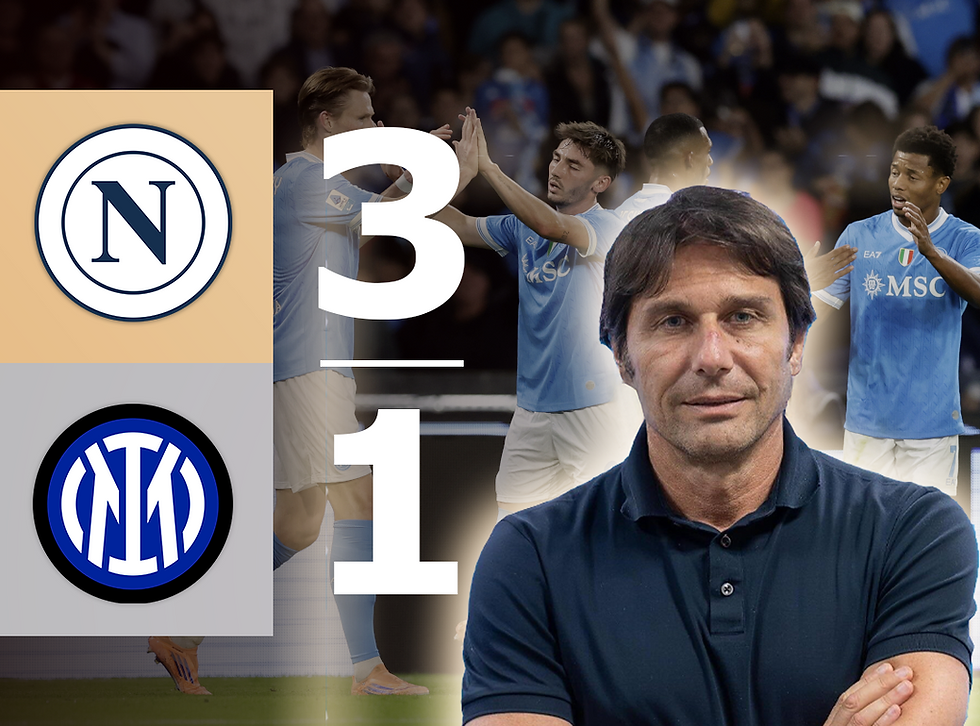
CONTE MASTERCLASS: NAPOLI 3-1 INTER MILAN: MATCH ANALYSIS
- Sourabh Banerjee

- Oct 28, 2025
- 5 min read

The Italian Serie A remains one of Europe’s most competitive leagues, comparable to the Premier League in its depth and unpredictability. Even mid-table sides are capable of challenging for top positions. The primary difference between the two leagues lies in financial capacity, with Serie A generally operating on a smaller economic scale. From a tactical perspective, however, Serie A continues to distinguish itself as one of the most sophisticated leagues in world football - particularly in its defensive organisation and structural intelligence.
This fixture brought together the two principal Scudetto contenders. Both teams had an opportunity to reach the top of the table following Milan’s 2-2 draw with Pisa. Consequently, victory in this match would have seen either side move into first place.
Psychologically, the two sides entered the contest in contrasting states. Napoli had suffered a heavy 6-2 defeat against PSV in their previous Champions League outing, while Inter arrived in high spirits after a convincing 4-0 win over Union Saint-Gilloise.
Line-ups and Initial Setup
Inter lined up in their familiar 3-5-2 structure. Sommer (1) started in goal, supported by a back three of Akanji (25), Acerbi (15), and Bastoni (95). Dumfries (2) and Dimarco (32) operated as wing-backs, while the midfield three supported the strike partnership of Martínez (10) and Bonny (14). Several key players were rested following their recent European fixture.
Napoli deployed a 4-1-4-1 formation but were notably weakened by injuries, particularly in attack. Interestingly, Conte opted to start Neres (7) in place of Lucca. With Højlund and Lukaku both unavailable, Neres—naturally a wide winger—was used as a central forward. His off-the-ball runs from wide areas proved influential throughout the game.
Both sides were forced into early substitutions within the opening half hour. Napoli replaced De Bruyne with Mathías Olivera (17), shifting Spinazzola (37) into a more advanced wide-forward role. Inter introduced Mkhitaryan for Zieliński (7).
(Starting XI for both teams)

Inter Milan’s Build-Up and Napoli’s Out-of-Possession Structure
Inter began the match assertively, dominating early possession and finishing with 56%. Much of their attacking threat stemmed from set pieces, exploiting the aerial presence of Bastoni and Dumfries. Despite striking the woodwork twice, they were unable to capitalise on these opportunities. From open play, Inter recorded 0.95 expected goals (xG), a figure inflated by a penalty valued at 0.79 following a handball incident. As the match progressed, their attacking momentum waned.
Inter’s pivot, Çalhanoğlu, initially dropped between the right and left centre-backs to assist in build-up. After approximately 20 minutes, he adjusted his position, moving between the central and left centre-backs to gain more time and space away from his direct marker, Billy Gilmour. Gilmour, however, adapted effectively, maintaining positional awareness to obstruct Çalhanoğlu’s passing options.

(Çalhanoğlu’s movement between centre-backs temporarily created a 4-2-4 structure in possession.)

(Gilmour positioned himself to limit passing lanes rather than engage tightly.)
Napoli’s defensive organisation was tactically nuanced—a hybrid between zonal coverage and man-oriented principles. Each player tracked an opponent loosely while maintaining focus on blocking central passing lanes, prioritising spatial protection over direct duelling. Their pressing intensity was situational rather than constant; they relied on a press-and-cover mechanism designed to delay rather than disrupt immediately. This approach often frustrated Inter, who struggled to identify free passing options or exploit space effectively.

(Napoli’s man-oriented zonal defence in a press-and-cover system.)
Inter targeted their left flank as the primary route of progression, maximising the width offered by Dimarco and Bastoni. With Çalhanoğlu drifting centrally, Bastoni operated wider than a typical centre-back, resembling a fullback in build-up play. Napoli maintained a deep defensive shape, tasking Anguissa with tracking Bastoni while simultaneously screening passing lanes to Mkhitaryan. However, this compactness was occasionally compromised during pressing triggers.
For instance, when De Bruyne pressed Sommer from the outside, he directed the goalkeeper into the inside pressing lane of Akanji’s marker. On the right, Politano abandoned Dimarco to press Bastoni, while Di Lorenzo, focused on retaining depth, was hesitant to step up. This created exploitable channels and led to temporary disorganisation. As the match progressed, Di Lorenzo became more vocal and proactive, adjusting his timing to close these spaces more effectively.

(A 2v1 scenario emerged against Anguissa.)

(Di Lorenzo’s delayed pressing created a domino effect in Napoli’s defensive chain.)
When space appeared between Napoli’s defensive and midfield lines, the side compensated through aggressive counter-pressing behaviours. They closed potential passing lanes to the receiver, with the defensive line stepping forward to engage Inter’s strikers while midfielders dropped to compress the ball carrier. This compact, collective reaction prevented Inter’s forwards—particularly Martínez and Borré—from linking effectively with their midfield.

(Napoli’s counter-press triggered when opponents received between the lines.)
In deeper phases, Napoli shifted into a 5-4-1 block, maintaining tight vertical distances and employing man-oriented pressure on Bastoni to disrupt his early deliveries. This balance between zonal structure and selective man engagement allowed them to nullify Inter’s wide progression. As Inter’s build-up became increasingly predictable, Napoli dismantled their attacks with composure and confidence.

(Napoli’s deep 5-4-1 block combined zonal protection with active ball pressure.)
Napoli’s Possession and Transition Play
In possession, Napoli built primarily from the goalkeeper, frequently using long kicks to bypass Inter’s asymmetrical 4-1-2-3 press. Their strategy centred on winning second balls, using McTominay and Anguissa as aerial and physical reference points to exploit depth and secure territory. This often led to 4v4 or 4v3 scenarios in advanced areas, creating favourable counterattacking situations.
However, Neres’s natural inclination to drift wide rather than attack centrally limited their directness. With Çalhanoğlu pressing higher, Neres found increased space on the ball. Conte’s structure facilitated effective second-ball recovery, operating in what resembled a 4-2-4 shape, with McTominay and Anguissa positioned high and Neres occupying the half-space between lines. Bastoni’s reluctance to engage aggressively in duels provided Neres with additional time to exploit these moments.


(Napoli’s success in second-ball situations created 4v4 transitions in the final third.)
In the mid-block phase, Napoli alternated between 2-3-5 and 3-2-5 structures depending on the centre-forward’s pressing role. For instance, Gilmour occasionally dropped alongside the centre-backs to create a 3v2 overload—a variation reminiscent of Salida la Volpe—enabling smoother progression through Inter’s first line. In advanced areas, McTominay’s penetrative runs complemented Neres’s movements, opening gaps within Inter’s defensive unit.

(Cross runs between Neres and McTominay disrupted Inter’s defensive compactness.)

(Gilmour’s drop created a 3v2 overload—Salida la Volpe—facilitating progression and depth runs from McTominay.)
Neres’s profile proved particularly effective within this framework. His lateral movements challenged the defensive coordination of Acerbi and Bastoni, stretching Inter’s compactness and creating exploitable spaces for McTominay, who eventually capitalised to score Napoli’s second goal on the counterattack.
Inter’s rest defence was a clear weakness. Their second line lacked aggression in contesting second balls near the opposition box, often resulting in 3v3 transitional vulnerabilities. Moreover, when Bastoni advanced and Çalhanoğlu dropped into the final rest-defence line, excessive gaps appeared between units. This allowed Neres to receive and distribute freely, with Acerbi preoccupied by depth cover and Çalhanoğlu failing to track McTominay’s runs effectively - further exposing structural fragilities.


(Increased gaps between rest-defence lines allowed Neres and McTominay to exploit free space.)
Conclusion
This match encapsulated Conte’s tactical acumen, particularly his mastery of out-of-possession organisation and counterattacking efficiency. His integration of man-oriented zonal structures, clear communication, and well-defined defensive triggers consistently disrupted Inter’s rhythm.
Conversely, Chivu’s Inter side suffered from a lack of attacking variation and structural cohesion during transitions and rest defence. The result further tightens the Serie A title race, reinforcing the league’s reputation for tactical sophistication and increasing unpredictability as the season unfolds.
Are You a Football Coach, Analyst or Scout?
Check out our store for professional-quality planners, tools, and resources designed to help you plan better, stay organised, and elevate your coaching game.


Brilliant breakdown!