.png)
HOW MUCH DOES ANGE’S FOREST LOOK LIKE ANGE'S SPURS?
- Sourabh Banerjee

- Oct 7, 2025
- 6 min read
Updated: Oct 9, 2025

Ange Postecoglou finds himself in a challenging position, still searching for his first win after three consecutive league defeats and a single draw. His tenure began with a 3–0 loss to Arsenal, setting a difficult tone for his early spell in charge. Nottingham Forest, previously managed by Nuno Espírito Santo, underwent the managerial change following internal disagreements between Santo and the club’s ownership.
The primary challenge for Ange’s Forest side extends beyond poor form. It lies in adapting to a dramatically different tactical identity. Under Santo, Forest favoured a more conservative approach, operating from compact low or mid-blocks and prioritising counterattacks initiated from deeper defensive positions.
In contrast, during the 2023–2024 season, Ange’s Tottenham team averaged a PPDA (passes per defensive action) of around 8, ranking among the league’s most aggressive pressing sides. Santo’s Nottingham, by comparison, averaged roughly 18, one of the lowest, as his teams relied more on long balls from the back rather than structured, vertical build-up play.
Implementing such a drastic stylistic shift in a short period is a significant challenge, particularly given that Ange’s more direct and high-risk approach requires a different player profile. This analysis explores the tactical problems Postecoglou faces at Forest and assesses how much he can realistically transform the team’s structure and performances.
Starting lineup against Newcastle
After the defeat against Sunderland, Ange switched from his usual four-man backline to a five-man backline, changing the formation from 4-2-3-1 to 3-4-2-1. This shift signals a more cautious and less attacking approach. The absence of key players like Zinchenko, who plays a crucial role in both build-up and final-third play - essential for Ange’s vertical style - likely contributed to this more defensive setup.
(The lineup of Nottingham against Sunderland, 4-2-3-1 - More Ange’s way.)
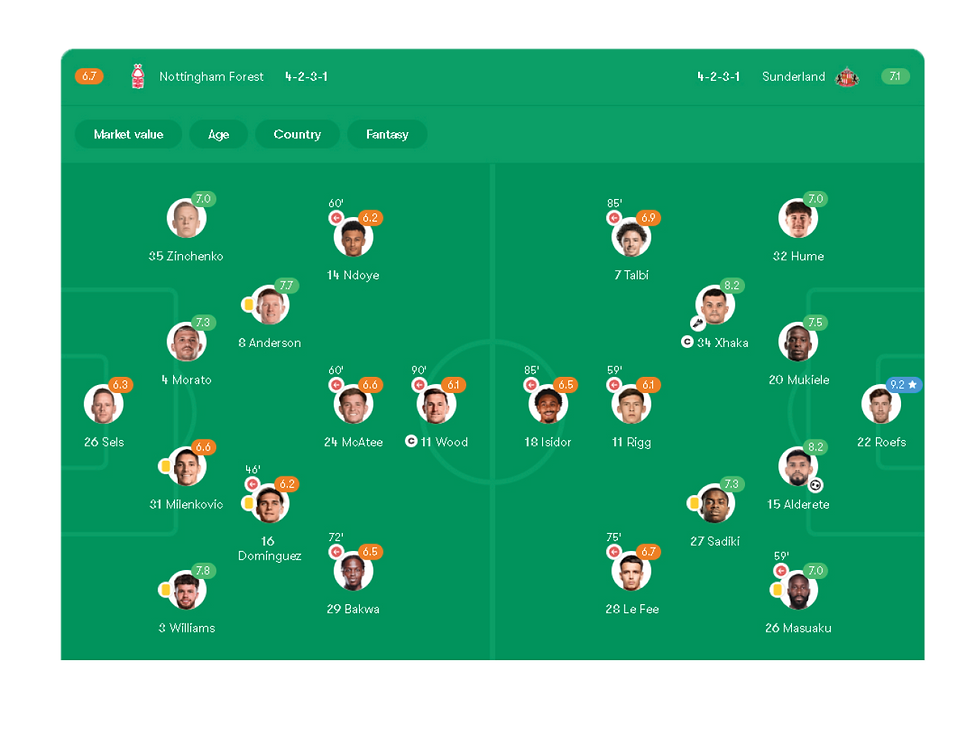
(The lineup of Nottingham against Newcastle, 3-4-2-1 - A more conservative line-up)

A fragile build-up against Newcastle
Howe’s Newcastle employ an intense high press built on man-to-man principles, making progression through their structure difficult. To counter this, Ange instructed central defender Milenković (31) to drop into midfield as an additional pivot behind Yates (22), while the goalkeeper functioned as a third centre-back between the two defenders. However, Newcastle’s coordinated shadowing, led by Gordon (10) and Woltemade (27), limited Forest’s ability to progress effectively.
The narrow positioning of Forest’s front line also aided Newcastle in maintaining their compact pressing shape, enabling Burn to step forward aggressively when needed. A potential alternative could have been for Milenković to shift wider as an asymmetric centre-back, which might have disrupted Newcastle’s pressing compactness and opened new passing lanes.
(Nottingham builds up against Newcastle at 6.46 minutes.)

The build-up phase began with the goalkeeper, who attempted to initiate attacks by playing directly from deep areas.
After struggling to progress through open play, Forest shifted their approach during set-play situations. Goalkeeper (Sels) opted for a long ball towards Wood and Gibbs-White, with Wood attempting to lay the ball off to the two attacking midfielders, Gibbs-White and Ndoye, positioned in the half-spaces. However, Newcastle’s tight man-oriented marking prevented Forest from exploiting any space behind the defensive line.
Both Gibbs-White and Ndoye lacked the acceleration and physicality required to add vertical threat in advanced areas, while Botman’s close marking of Wood ensured the striker lost most aerial duels. The core issue stems from Wood’s playing profile; he is not a natural hold-up forward capable of retaining possession and creating effective passing lanes for supporting teammates.
In contrast, at Spurs, Dominic Solanke often dropped deeper to hold up play and link with advancing teammates. This highlighted the lack of structural planning and timing in Forest’s approach under Ange, differing notably from Postecoglou’s Tottenham, where the use of inverted full-backs in midfield created clearer vertical passing routes from centre-backs to wide players.
(At the 23.45 minutes build-up set up)

Overload the left side and box overload for chance creation
In the first half, Nottingham Forest managed to create only one notable opportunity and struggled to threaten the goal against Newcastle’s organised 4-5-1 mid-to-deep block. Forest operated in a structured 3-2-5 shape, with both wing-backs providing width to stretch the opposition and overload the defensive line. The team directed much of its play down the left flank, where Ndoye and Willms pinned Newcastle’s full-backs and centre-backs, generating a 4v2 numerical advantage around the ball.
Wood operated as a false nine, frequently dropping between the lines to link play, while Ndoye and Gibbs-White made penetrating runs in behind the defensive line. In the final third, Savona advanced into the penalty area to create an additional presence, producing a 3v2 overload during crossing situations.
(Nottingham overloaded the last line 5 v 4 and pinned the side of the fullback and centre back, and also made an overload around the ball.)

(Savona wingback arrived and made a box overload in the far post.)

During Ange’s tenure at Spurs, the attacking structure featured far greater fluidity and rotational movement. The full-backs, particularly Udogie, regularly advanced into the half-spaces, making underlapping runs that were both energetic and difficult for defenders to anticipate. In the final third, Spurs often prioritised low, driven crosses rather than high deliveries toward the far post. This tactical difference was likely influenced by the presence of Wood, whose profile prompted a shift away from aerial-focused attacking patterns.
A Passive Out-of-Possession Approach and Numerical Disadvantage in Pressing
This phase of play represented the most decisive tactical contrast, with Newcastle dominating possession largely due to Nottingham’s passive 5-4-1 defensive structure, which applied minimal pressure on the ball. Wood offered little physical presence in the press, and the 5-man backline effectively created a 5-versus-7 disadvantage higher up the pitch, while midfield duels often resulted in a 3-versus-2 superiority for Newcastle.
Eddie Howe’s side utilised a fluid 4-3-3 system, with defensive midfielders such as Tonali and Guimarães frequently dropping into deeper positions to act as pivots. This movement disrupted Nottingham’s man-marking scheme and created difficulties for midfielders Yates and Anderson in maintaining compactness.
Newcastle’s primary attacking threat emerged down the right flank through the combination play of Elanga and full-back Trippier, who consistently exploited space to deliver crosses into the box. On the opposite side, Burn maintained a more conservative role, supporting the centre-backs and reinforcing the team’s defensive balance.
(Nottingham 5v3 in the back gives a disadvantage in other areas at minute 1)

As the match progressed, Wood adopted a more passive role, focusing primarily on shadowing Tonali rather than initiating pressure. The team’s pressing trigger shifted, with Ndoye pressing from the outside to the inside against centre-back Thaiw while simultaneously attempting to screen Trippier. Despite this adjustment, Newcastle continued to bypass pressure effectively, as Guimarães or even Woltemade frequently dropped into the right half-space to receive possession before switching play toward Trippier or Elanga.
(How Newcastle bypassed Nottingham’s pressing)

Trippier maintained width on the right flank in the final third, creating space in the inside channel for Elanga to exploit. In addition to stretching the defensive line, Trippier provided incisive through balls to teammates making runs inside. Elanga’s inward movements effectively pinned Williams, giving Trippier both the time and space needed to deliver crosses from wide areas. Despite this pressure, Nottingham defended the box relatively well, dealing effectively with most of Elanga’s deliveries.
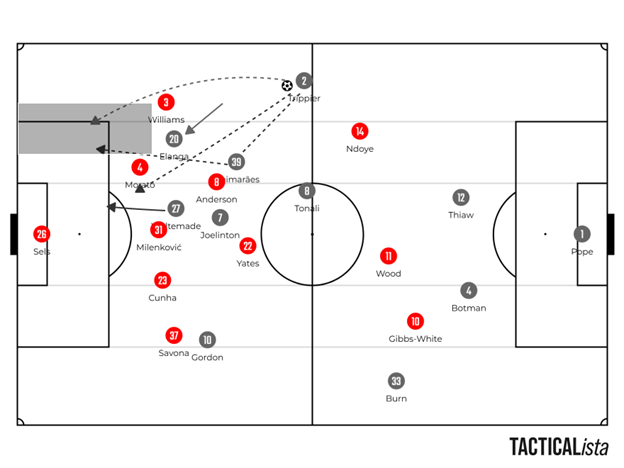
Nottingham also displayed passivity during defensive-to-attacking transitions, which directly contributed to conceding a goal under Newcastle’s counter-press. Guimarães capitalised on this lapse by scoring from zone 14.
In contrast, Ange’s Tottenham sides were recognised for their proactive defensive approach, maintaining an aggressive high line - often as high as the halfway line. A notable example came in November 2023, when Spurs, reduced to nine men against Chelsea, continued to defend boldly on the front foot.
Conclusion
Nottingham’s current style of play more closely resembles Nuno Espírito Santo’s approach than that of Ange’s Spurs era, marked by a clear lack of intensity in pressing and a reduced emphasis on vertical attacking. The result is a more passive, defence-oriented structure. Ange’s commitment to his playing philosophy is well documented, meaning he will likely need more time to embed his ideas effectively.
The existing player profiles also present challenges. Wood functions primarily as a poacher rather than a runner in behind or a hold-up forward, while the squad lacks wingers with consistent 1v1 ability to beat full-backs. Moreover, apart from Zinchenko, the full-backs have yet to demonstrate the technical quality required to influence play in midfield or the final third.
With points continuing to slip away, sustaining competitiveness in the Premier League will be increasingly difficult. Nottingham currently sit precariously in 17th place, hovering just above the relegation zone. How quickly Ange can reshape the team’s identity will determine whether Forest stabilise or continue to struggle in the weeks ahead.


Excellent analysis! 👏 Very detailed and well-structured. Clear comparison between both. Player profile mismatch plus buildup and pressing- very well put up. Tactical clarity top-notch!
Great Analysis...