.png)
THOMAS TUCHEL'S ENGLAND - WILL BALANCE BEAT BRILLIANCE?
- Mohamed Fathalli

- Oct 10, 2025
- 6 min read

Thomas Tuchel faced heavy criticism after announcing his latest England squad to face Wales and Latvia, with the biggest shock being the omission of star midfielder Jude Bellingham. Other in-form players like Phil Foden, Adam Wharton, and Jack Grealish were also left out, while the inclusion of unpopular choices such as Jordan Henderson and Ruben Loftus-Cheek drew further scrutiny.
Bellingham’s exclusion can partly be explained by his limited game time this season, with just four appearances and one start, but Tuchel insisted his decision was about rewarding the squad that ‘set the standards’ against Serbia. He emphasised continuity, momentum, and unity, values often missing from England teams in the past but reintroduced under Gareth Southgate, and ones Tuchel appears keen to strengthen.
With England’s talent pool deeper than ever, competition for places is fierce. The convincing 3–0 win over Wales reinforced Tuchel’s approach and likely intensified the motivation of those left out. Yet a big question remains: will he stick with this trusted core heading into the 2026 World Cup, or reintroduce stars like Bellingham, Foden, and Wharton while phasing out the current regulars?
The 52-year-old seems intent on building a united, future-ready squad and challenging excluded players to fight their way back. It’s hard to imagine a coach of Tuchel’s calibre doubting the quality of players like Bellingham, Foden, or Wharton, only pushing them to meet his standards.
Basics Bring Balance:
Looking at the starting lineup against Wales, nothing really stood out as surprising or unusual. And maybe that’s exactly the point. Every player was used in a position that felt natural to them, a role they already understood. That sense of familiarity created balance across the pitch.
The midfield three is a perfect example of that idea: a proper six in Elliott Anderson, an eight in Declan Rice, and a ten in Morgan Rogers. Each one had a clear job, and together they formed a unit that looked organized and confident. Even the “oddest” choice, if we can even call it that, was Ezri Konsa, but even he has played as a right-back before. Nothing felt forced or experimental, just players doing what they know best, and that simplicity made all the difference.

That in turn allowed Tuchel to implement his style of play: fluid, front-footed and vertical.
Playing Into Pressure:
Taking as an example this build-up sequence. England’s backline players, including Pickford, were not afraid to play straight into pressure instead of finding the easy route around Wales’ 4-4-2 press. This was down to multiple things: the technical security of both Guehi and Stones, Anderson’s clever movement to receive, and Rice’s dynamism off the ball.
What this did was manipulate Wales’ press by having players retain the ball under pressure and constantly move without the ball to create space for each other.

In the sequence above, you’d think the move was finished as Spence received the ball with immediate pressure coming from his side. However, England’s players managed to circulate possession under pressure, inviting more Wales players to step higher up the pitch. They then relied on Anderson’s ability to retain and turn on the ball to once again find the free man and push the opposition’s block back.

Now I wonder who the other English midfielder is who can play as a number six, drop deep to collect the ball, stay composed under pressure, and split defenses with his passing. The name is Adam Wharton. And while Anderson has been one of the best and most consistent midfielders in England so far, Wharton might have an edge over him at some point because of his left foot. Having a left-footed midfielder is simply a necessity. England currently have no one with that trait, and to open up more passing options and unlock different build-up approaches, having a left foot in the middle of the park could be crucial for adding variation against tougher and more organized pressing teams.
Expression Within Structure:
In settled possession, England mainly started in a 4-2-4 shape. However, that structure was anything but fixed. Both Anderson and Rice took turns dropping between or alongside the center-backs to help circulate possession or find progressive options. This was made possible by Spence’s constant movement and deep runs to join the midfield line as he rotated with Rice in this example. That, in turn, allowed England to overload the left-hand side, giving Gordon space to drop and receive the ball or isolate his marker in one-on-one situations where he could cut inside to combine or switch play.

In fact, the dynamic on the left-hand side between Spence and Gordon was one of England’s main methods of chance creation in this game. The first opportunity of the match, which fell to Gordon himself, was a direct result of this combination.
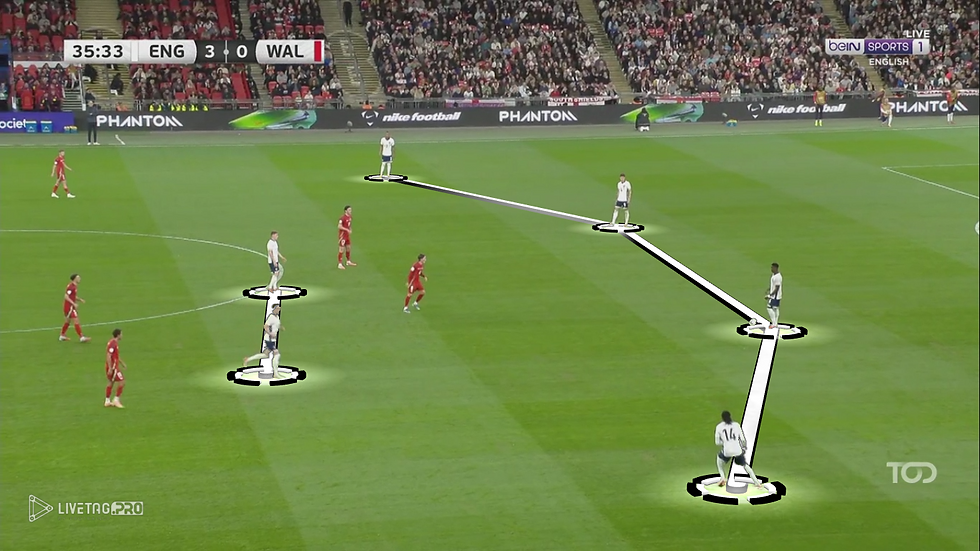


Even Saka’s brilliant goal came from a sequence that began with Gordon and Spence combining down the left before progressing the play with pace and skill.

Which brings us back to another name we mentioned earlier. Gordon performed brilliantly in this game; however, combining in tight spaces after cutting inside from the left might not be his strongest area. That role seems tailor-made for someone like Jack Grealish, whose main strengths lie in picking up dangerous positions, retaining the ball under pressure, and driving inside to combine and create. If this doesn’t encourage Grealish to work his socks off even more to prove himself once again, I don’t know what will.
Phil Foden could also be in contention to play this role, although he’s not seen as an out-and-out winger but more of an inside player who likes to receive between the lines. So perhaps he and Bellingham would be eyeing Rogers’ position.
Off Ball Movement is Your 12th Man:
Aston Villa’s star player needed less than three minutes to open his account for the England national team, scoring his first goal in his ninth appearance. His overall performance was also solid, showing powerful ball carrying and a strong presence in the box behind Watkins. He frequently dropped deep to receive, retain, and progress the ball through his carrying.

What he also did was provide a passing option to execute up, back, and through patterns, helping pull Wales’ block apart and allowing England to play through or over it. His off ball movement was key here.

This kind of movement is something that Foden and Bellingham would also thrive on. Their technical security and positional awareness would be crucial for these patterns and for adding more unpredictability against different teams. Another aspect the Real Madrid star would excel in is making runs in behind, which is also something Tuchel demanded from his players.
In the second half, Anderson operated as the lone pivot in possession, with Rice pushing higher up on the left-hand side. From there, the England captain for the night kept making deep runs beyond Wales’ backline to stretch the opposition vertically and receive long balls over the top. Although that wouldn’t be the exact position Bellingham would occupy, these types of actions are where he can cause real problems for different opponents, providing constant runs and a strong physical presence against defensive lines.

In the end, what Tuchel is trying to build with this England team seems clear. He wants balance, structure, and unity. These are foundations that can allow talent to truly shine. His squad choices might have raised questions, but the performance against Wales offered some answers. It showed that his ideas are starting to take shape, that the basics are in place, and that every player on the pitch understands their role.
Leaving out players like Bellingham, Foden, Wharton, and Grealish might have seemed harsh, but perhaps it’s part of a bigger plan. Tuchel appears focused on creating a strong, connected core first, then gradually reintegrating those stars into a system that already functions smoothly. Watching England play with such control, intensity, and confidence makes it easy to see why he values continuity and cohesion so highly.
If this is the direction England are heading under Tuchel, then there’s every reason to be excited. The blend of tactical discipline and raw talent could finally bring back the kind of football England fans have long been waiting to see - fearless, fluid, and full of purpose.
Looking For Products to Enchance Your Analysis & or Coaching?
The One Pitch Planner is perfect for mapping out ideas just like this England squad depth. Whether you’re breaking down formations, planning training sessions, or analysing tactical structures, it helps you visualise everything clearly and professionally.
Designed for coaches and analysts, it’s one of many tools available at The Coaches Zone, alongside training & matchday planners, tactics boards, and of course our famous X-Planner range - all created to make planning simple, organised, and effective.


Comments